Where Are Samsung Phones Made? The Full Country List
Samsung phones are built mainly in Vietnam, India and South Korea. Here is which country makes which model, and why Samsung left China entirely.
Short answer
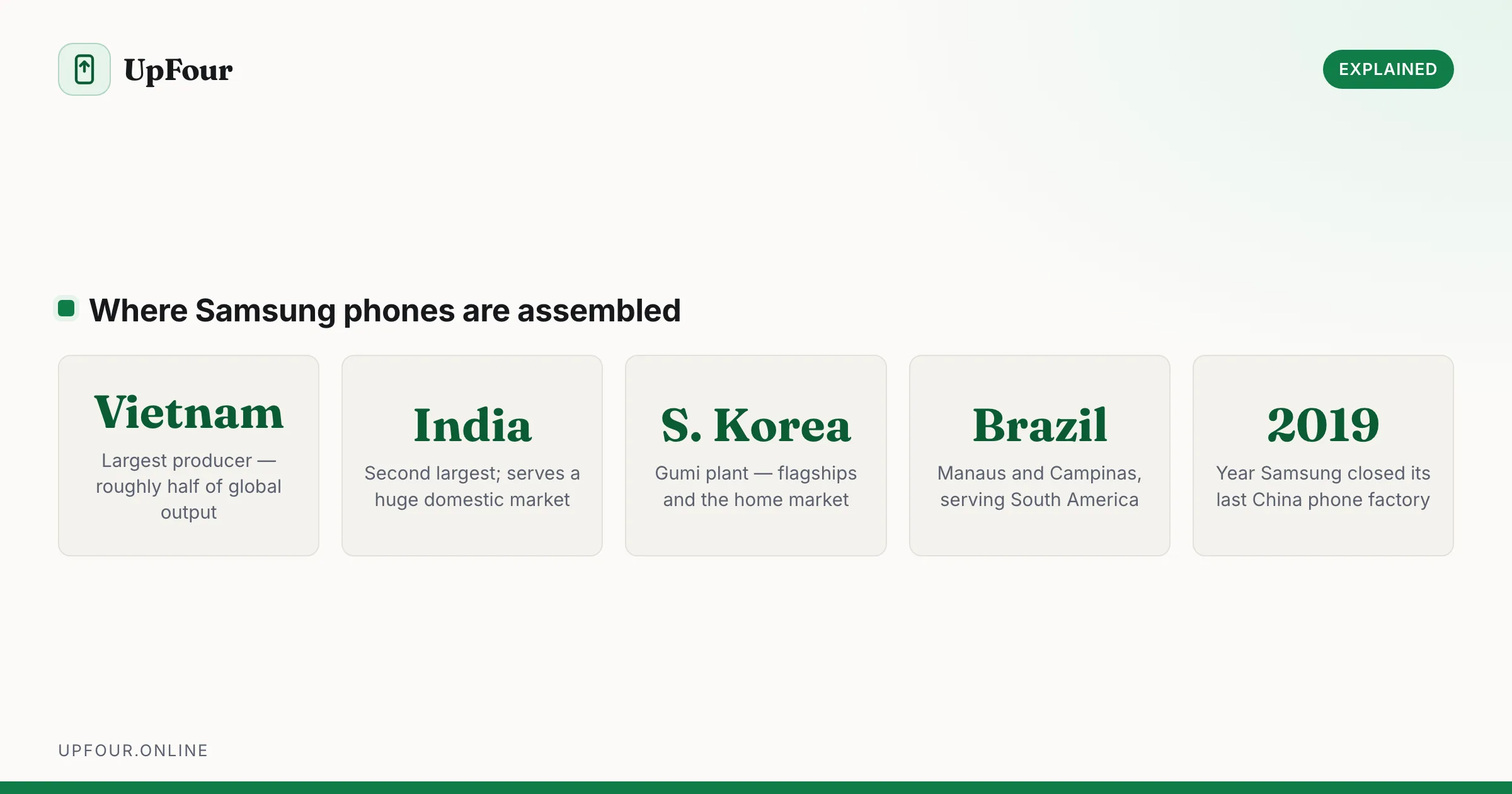
Most Samsung phones are made in Vietnam, which produces roughly half of Samsung's global smartphone output. India is the second-largest source, followed by South Korea, Brazil and Indonesia. Samsung closed its last Chinese phone factory in 2019.
Samsung is a South Korean company, but comparatively few Samsung phones are made in South Korea. Manufacturing is spread across a handful of countries, and which one built your handset depends mostly on where you bought it.
The main manufacturing countries
| Country | Role |
|---|---|
| Vietnam | Largest producer — roughly half of global output |
| India | Second largest; supplies India and exports widely |
| South Korea | Gumi plant; flagship and domestic production |
| Brazil | Manaus and Campinas; serves South America |
| Indonesia | Domestic market and regional supply |
Vietnam
Samsung's largest phone manufacturing base by a wide margin, concentrated in the northern provinces of Bac Ninh and Thai Nguyen. Samsung is among the largest foreign investors and employers in Vietnam, and its factories there account for a substantial share of the country's total exports.
If you bought a Galaxy phone in Europe, the Middle East or much of Asia, Vietnam is the most likely origin.
India
Samsung's Noida facility, near Delhi, is one of the largest mobile phone plants anywhere in the world. It was built to serve India's enormous domestic market under local manufacturing incentives, and it now exports as well.
Phones sold in India are almost always made in India.
South Korea
The Gumi plant continues to operate, focused on flagship models and the domestic market. Volume is small relative to Vietnam and India — South Korea is where Samsung designs and engineers phones far more than where it assembles them at scale.
Samsung left China
Samsung closed its last Chinese smartphone factory in 2019, ending phone manufacturing in the country entirely.
The reasons were straightforward: rising Chinese labour costs, and a collapse in Samsung's market share in China itself, where domestic brands such as Huawei, Xiaomi, Oppo and Vivo came to dominate. With little domestic market left to serve and cheaper labour available in Vietnam and India, the factories no longer made sense.
So a Samsung phone bought today is not made in China, though some components within it are manufactured there — which is true of essentially every consumer electronics product regardless of brand.
How to check where your own phone was made
Three ways, in order of reliability:
- The retail box. Look for "Made in ___" printed in the small text near the barcode and regulatory markings.
- Under the battery / on the frame. On older removable-battery models, the label sits under the battery. On modern phones, check the fine print on the SIM tray or the rear casing.
- Settings › About phone. Some regional builds display manufacturing details, though many do not.
The model number is also a strong regional hint — the suffix after the model code indicates the market variant, which usually correlates with the manufacturing site.
Does the country of manufacture affect quality?
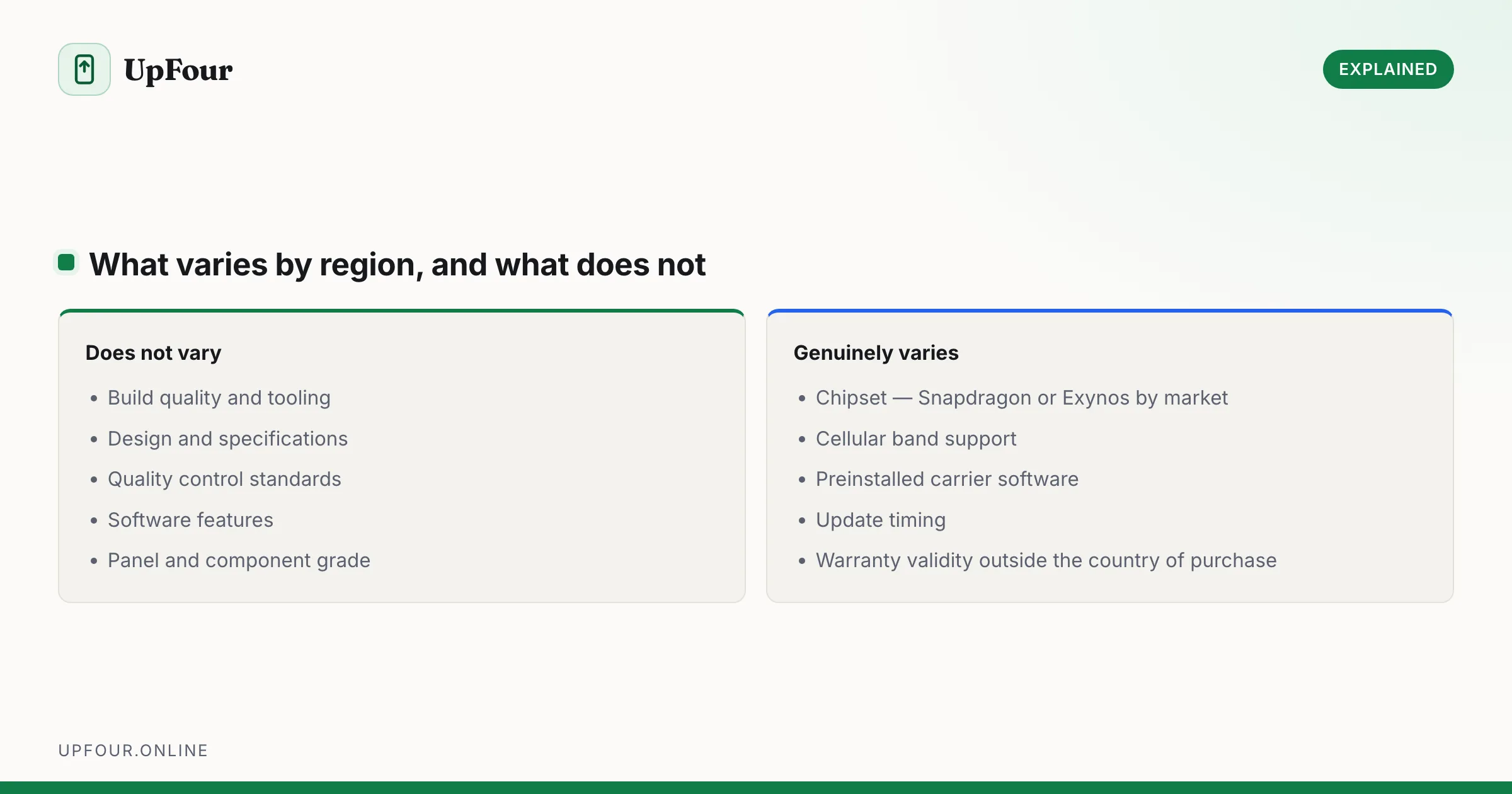
Not meaningfully. Samsung applies the same specifications, tooling and quality control across its plants, and the factories build to identical designs. A Galaxy made in Vietnam is not a lesser product than one made in South Korea.
What does vary by region:
- Model variants. Some regions get different chipsets — Snapdragon in some markets, Exynos in others — for the same model name. This is a genuine difference, and it is decided by market, not by factory.
- Bundled software. Carrier and regional builds differ in preinstalled apps.
- Band support. Cellular band compatibility varies by market, which matters if you import a phone.
- Warranty. Usually valid only in the region of purchase. This is the most common real-world problem with imported handsets.
Where components come from
The assembly country is only part of the picture. A Galaxy phone contains parts from across the industry:
- Displays — Samsung Display, largely South Korea and Vietnam.
- Memory and storage — Samsung Semiconductor, South Korea, plus SK Hynix and Micron.
- Processors — Samsung's own Exynos fabricated in South Korea, or Qualcomm Snapdragon fabricated by TSMC in Taiwan.
- Camera sensors — Samsung ISOCELL and Sony, the latter from Japan.
- Batteries and passive components — a mix of Chinese, Japanese and Korean suppliers.
"Made in Vietnam" describes final assembly. No smartphone from any manufacturer is sourced from a single country.
What about Samsung TVs and appliances?
Different supply chain entirely — Samsung TVs are made in Mexico, Hungary, Slovakia, Vietnam, India and elsewhere. See where Samsung TVs are made for that breakdown.
In short
Samsung is South Korean, headquartered in Suwon. Its phones are assembled principally in Vietnam, then India, with smaller volumes from South Korea, Brazil and Indonesia. None are made in China. The country on the box has no bearing on quality, but the regional model variant can genuinely differ in chipset and band support.
Frequently asked questions
Where are Samsung phones made?
Mostly in Vietnam, which produces around half of Samsung's global smartphone output, followed by India, South Korea, Brazil and Indonesia. Samsung is a South Korean company but assembles comparatively few phones there.
Are Samsung phones made in China?
No. Samsung closed its last Chinese smartphone factory in 2019 after labour costs rose and its market share in China collapsed. Some individual components are still manufactured in China, as with nearly all consumer electronics.
Does it matter which country made my Samsung phone?
Not for quality — Samsung builds to the same specifications at every plant. Regional model variants can differ in chipset and cellular band support, and warranties are usually valid only in the region of purchase.
How can I tell where my Samsung phone was made?
Check the retail box for a Made in marking near the barcode, or the fine print on the phone's frame or SIM tray. The model number suffix also indicates the regional variant.
Sources & further reading
Official documentation used while writing and checking this guide. Every link was verified at the last update.
- Samsung Global NewsroomSamsung
- Samsung phone specifications databaseGSMArena
- Official Samsung SupportSamsung
Machine-readable version: Markdown source
Related guides
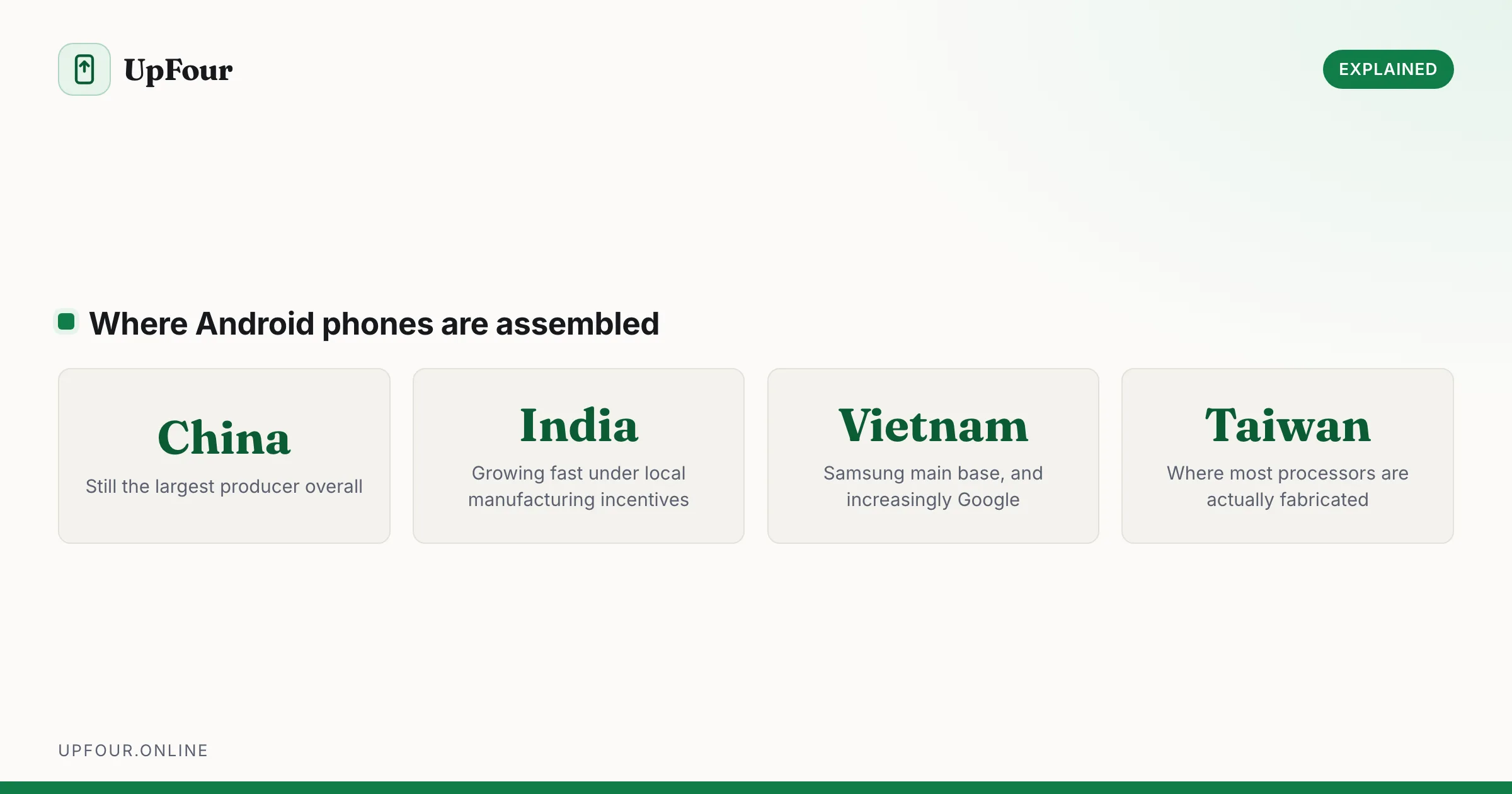
Where Are Android Phones Made? Manufacturing by Brand
Which countries make Android phones, brand by brand — Samsung, Google Pixel, Xiaomi, OnePlus and Motorola — and why so much moved out of China.
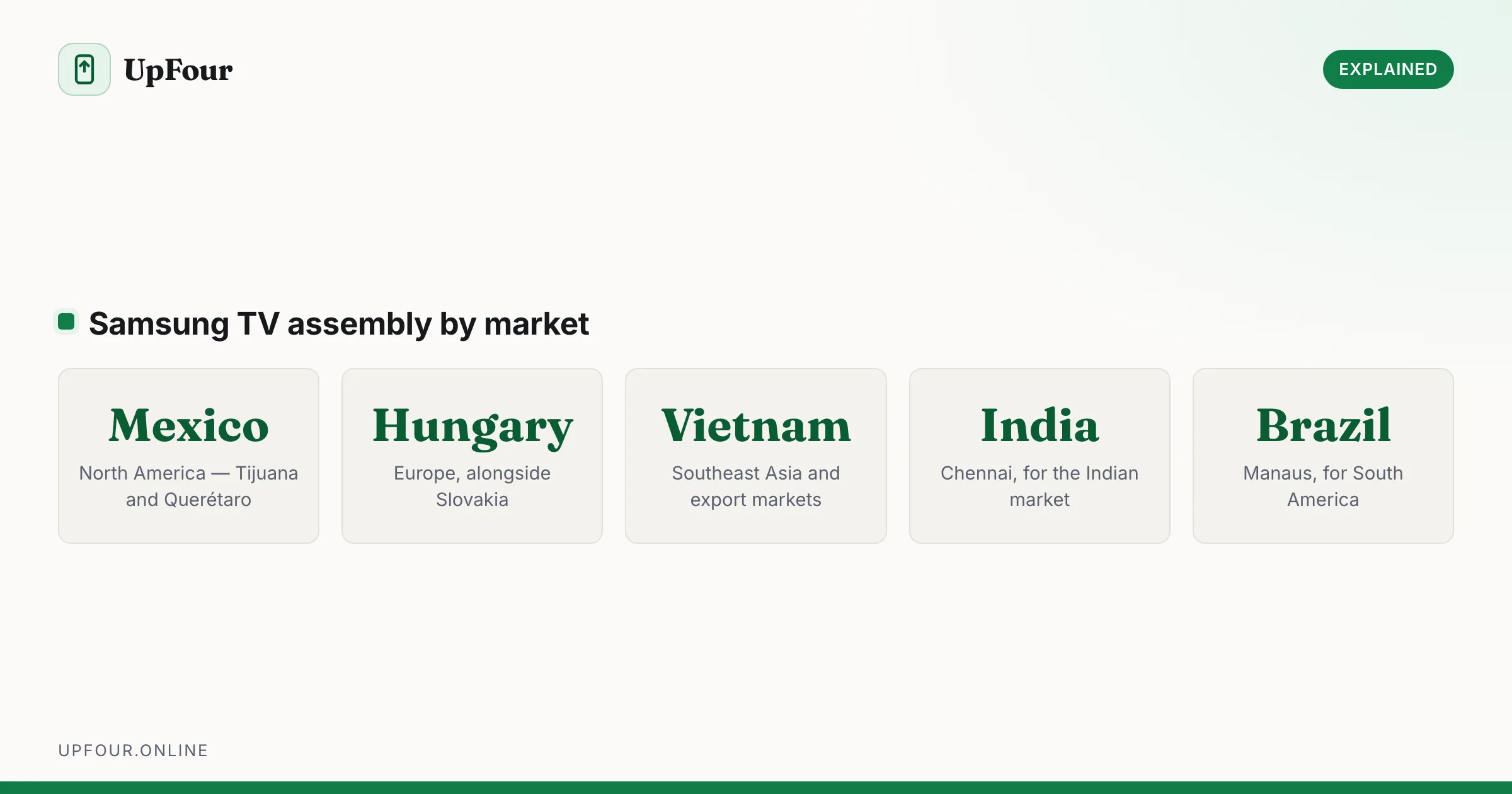
Where Are Samsung TVs Made? Country List by Region
Samsung TVs are built in Mexico, Hungary, Slovakia, Vietnam, India and elsewhere. Here is which plant supplies which market, and where the panels come from.

Galaxy S Release Dates: Every Samsung Flagship in Order
A complete timeline of Samsung Galaxy S release dates from the original through recent models, plus when Samsung typically launches new phones.